
Let's finally get professionalism right.
Dismantling centuries of standards and biases is no easy feat, but if we're to move forward in a productive manner, we have to start poking at the systems keeping these ideals afloat.

Unpacking antiquated ideas of professionalism should be a non-negotiable. It’s not a nice-to-have, not a one-time initiative, and certainly not a conversation to be pushed to another time. And yet, here we are — still having it.
89.4% of employers rate professionalism as important for recent college graduates entering the world of work. But, only 50.3% say recent graduates are actually proficient in it. Before we accept that as evidence of a generation that’s falling short, I think we owe it to ourselves and, especially, our future of work, to ask a more uncomfortable question: Who wrote the definition, and who does it serve?
Professionalism, as most institutions have defined it, was never a neutral standard or equitably achievable goal. It was always a colonialist one.
When the people constructing and enforcing a standard don’t reflect the people being measured against it, what we’re looking at isn’t a skills gap—it’s a power gap. It’s a belonging gap. It’s a an impossible standards gap. And, in many cases, it’s a gap that was built deliberately, even if it’s sustained subconsciously (or, in the worst cases, deliberately).
The personal became professional for me a few years ago.
A few years ago, I was at a work event—sleeveless top, blue slacks, boots, feeling good. I really liked these blue pants. They don’t fit anymore, but they were that shade of blue and had the kind of sharp cut that made me feel like I was somebody.
I was doing exactly what I was supposed to be doing: networking with colleagues, connecting with students, being present in the work. And then, a colleague commented negatively (and, admittedly, inappropriately) on my tattoos.
Earlier that year, I was eagerly chatting with a founder, one of my first conversations with someone in the space. I didn’t know what I was doing, but I was having a great time building connections. And then, as we were ending the call, she told me I looked 14.
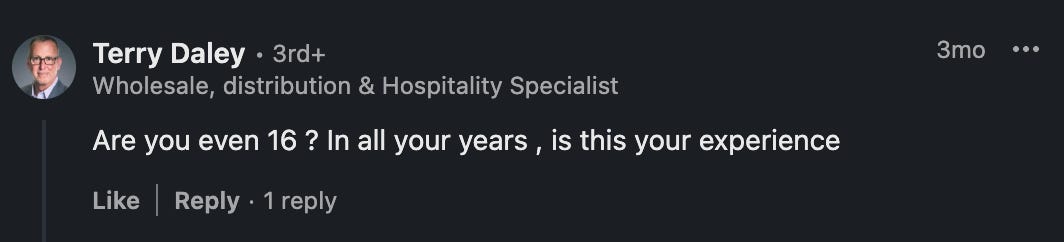
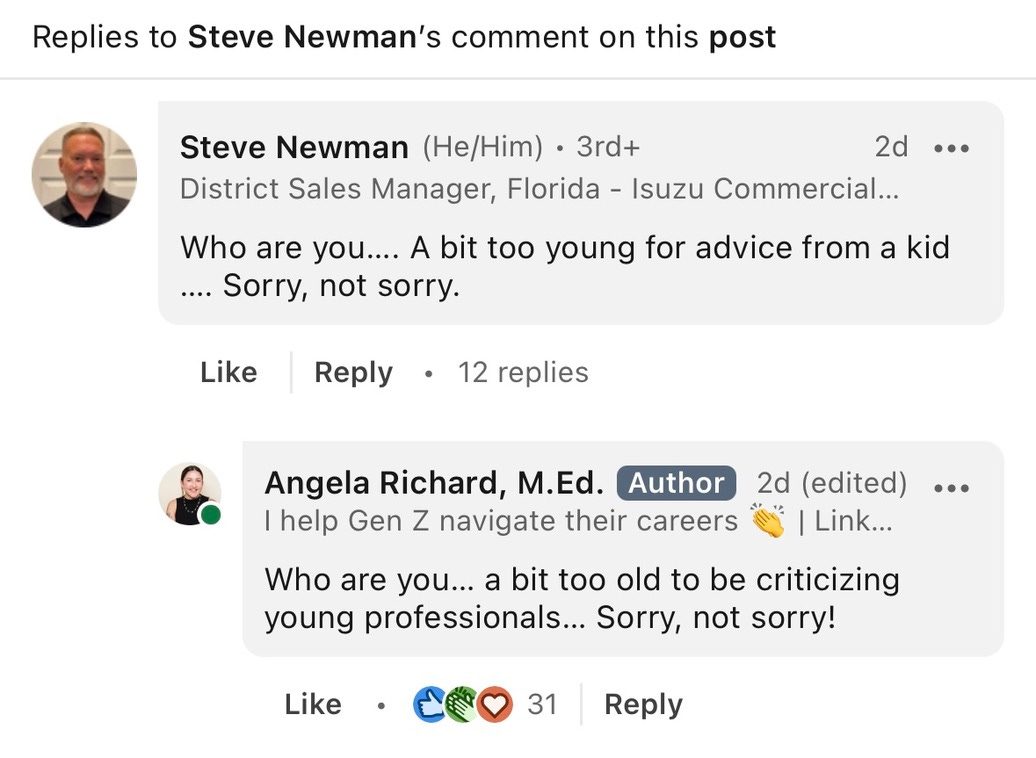
I’ve had folks on LinkedIn tell me I’m too young to be giving advice, on everything from advice posts to anecdotes about my own journey.
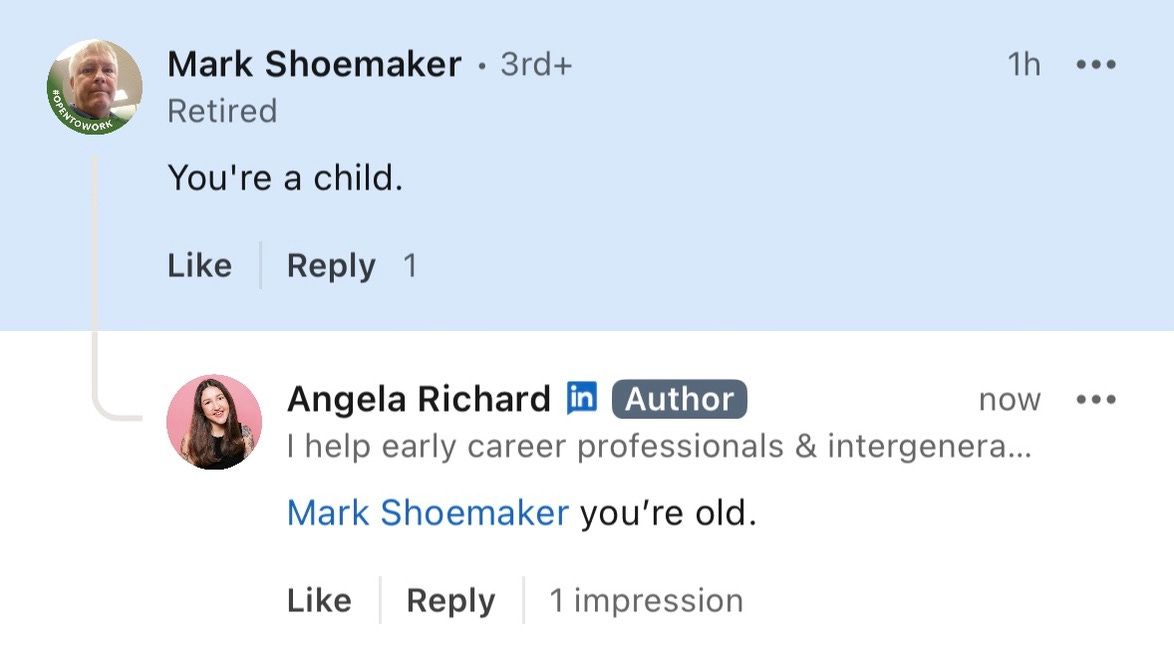
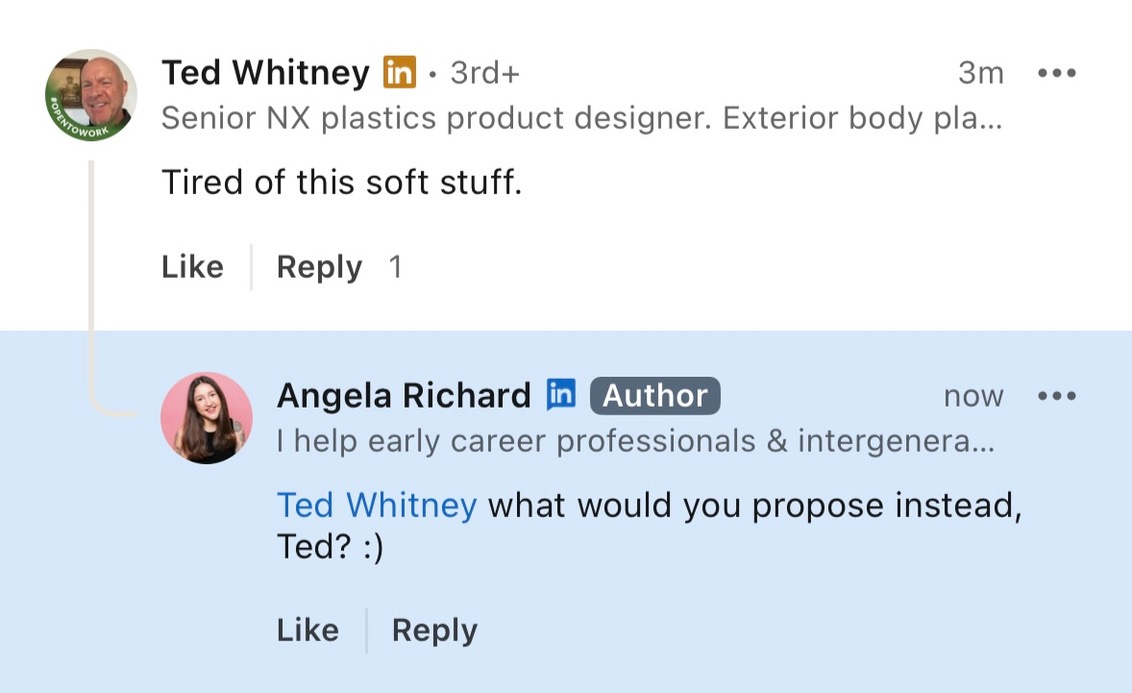
Those interactions didn’t just sting at the time. They revealed something. They demonstrated that, in certain professional spaces, my ability to do the work was secondary to whether I “looked the part.” Evaluating employees on anything unrelated to their skills or abilities dismisses their capacity based on standards that have no impact on their work. That’s not professionalism.
Those experiences (and my usual replies to these kinds of comments) are part of why I named my business Professionally Unprofessional, and they’re part of why I keep coming back to this conversation year after year. Because the early career professionals I work with—particularly first-generation students and young people from underrepresented backgrounds—are carrying this weight constantly. Not exhaustion from the work itself, but from the performance required to be perceived as worthy of doing it.
The code-switching. The second-guessing. The constant imposter syndrome. The quiet calculation of how much of yourself you can bring into a room before it starts to cost you something.
Professionalism should relate to how you do your work, not whether your identity is palatable enough for the job.
The rubric is doing more work than we admit.
When employers report that recent graduates lack professionalism, the data deserves interrogation. Because in practice, professionalism is often measured through proxies: Does this person communicate the way we do? Do they carry themselves the way we expect? Do they feel familiar? That last question is doing a lot of heavy lifting, and it has a well-documented track record of disadvantaging people of Color, first-generation professionals, neurodivergent workers, and anyone whose upbringing didn’t include an informal preview of what dominant workplace culture looks, sounds, and feels like.
“Cultural fit” functions as a professionalism criterion in more organizations than would ever admit it, and the consequences are not evenly distributed. When we treat familiarity as a quality indicator, we are not evaluating competence. We are prioritizing conformity. We are penalizing people, often systemically, for the distance between who they are and who the institution imagined when it wrote its norms.
This is not a pipeline problem. It is, precisely, a “professionalism” definition problem. And, until organizations are willing to examine the definition, no amount of recruitment outreach or DEI programming is going to close the gap they keep measuring.
Redefining professionalism is not the same as abandoning standards.
I want to be clear about this, because the argument gets flattened in both directions. Redefining professionalism is not about telling people that anything goes, or that accountability and follow-through and effective communication no longer matter. Of course, they matter. What it is about is doing the work of separating standards that are genuinely tied to performance from preferences that are tied to culture, history, and comfort—and then being determined to act on what you find.
In practice, that looks like reimagining “cultural fit” in hiring criteria with “cultural contribution.” It looks like decoupling appearance from performance evaluations and considerations for promotion, because how someone wears their hair or dresses their body has no meaningful relationship to how well they can do a job, and pretending otherwise is a clear choice that organizations make. It looks like teaching the typically unwritten rules explicitly rather than using ignorance of them as a screening mechanism, because first-generation professionals are disproportionately penalized for not knowing norms they were never taught and were never meant to learn outside of proximity to the right people and the right rooms.
None of this requires lowering a bar. It requires being honest about what the bar has been measuring for decades.
The organizations getting this right are not doing less or trying to avoid conversations around professionalism all together. They’re doing better.
The research on belonging and organizational performance has been consistent for years: when people are able to show up as themselves, psychological safety increases, creativity increases, retention increases, and output improves. Not without authenticity, but because of it. We have known this for a while. We’ve probably all felt it at some point or another. The question is whether organizations are actually willing to be changed by it, or whether it’s easier and more comfortable to keep operating as normal, perhaps highlighting their “expansive” outlook on professionalism through ad hoc or one-time programs.
The workplaces that are genuinely thriving in 2026 and beyond are not the ones that are encouraging every employee to conform to a single image. They are the ones that get clear about what truly matters for doing excellent work and work with their teams to build environments where people’s energy is valued. I’ve had to tell many employees that authenticity and excellence are not mutually exclusive. I have built my entire practice on that belief, and I have seen it hold up across industries, career stages, and organizational contexts.
The standard has never been neutral. Dismantling baked-in ideas of professionalism means we’re being honest about what we’re really requiring or expecting in the world of work.
In 2026 and beyond, the organizations and institutions that want to retain talented people, build real cultures of belonging, and stay accountable to the world their employees actually live in will need to do this work. Not as a gesture, not as a line item in a five-year strategic plan, not as a one-time training or workshop. But, as a genuine grappling with who their definitions of professionalism were written for, and who has been paying the cost of that ever since.
That conversation is long overdue. And, I hope to stop being one of the few people having it.
I host events in the greater Boston area. Check them out below!
Stay connected on all platforms:
LinkedIn | TikTok | Instagram